Idea Index - The Brainstorming Book I Keep Coming Back To
Rapid fire generative AI technology can produce endless variations. But variation alone doesn't always create good work.

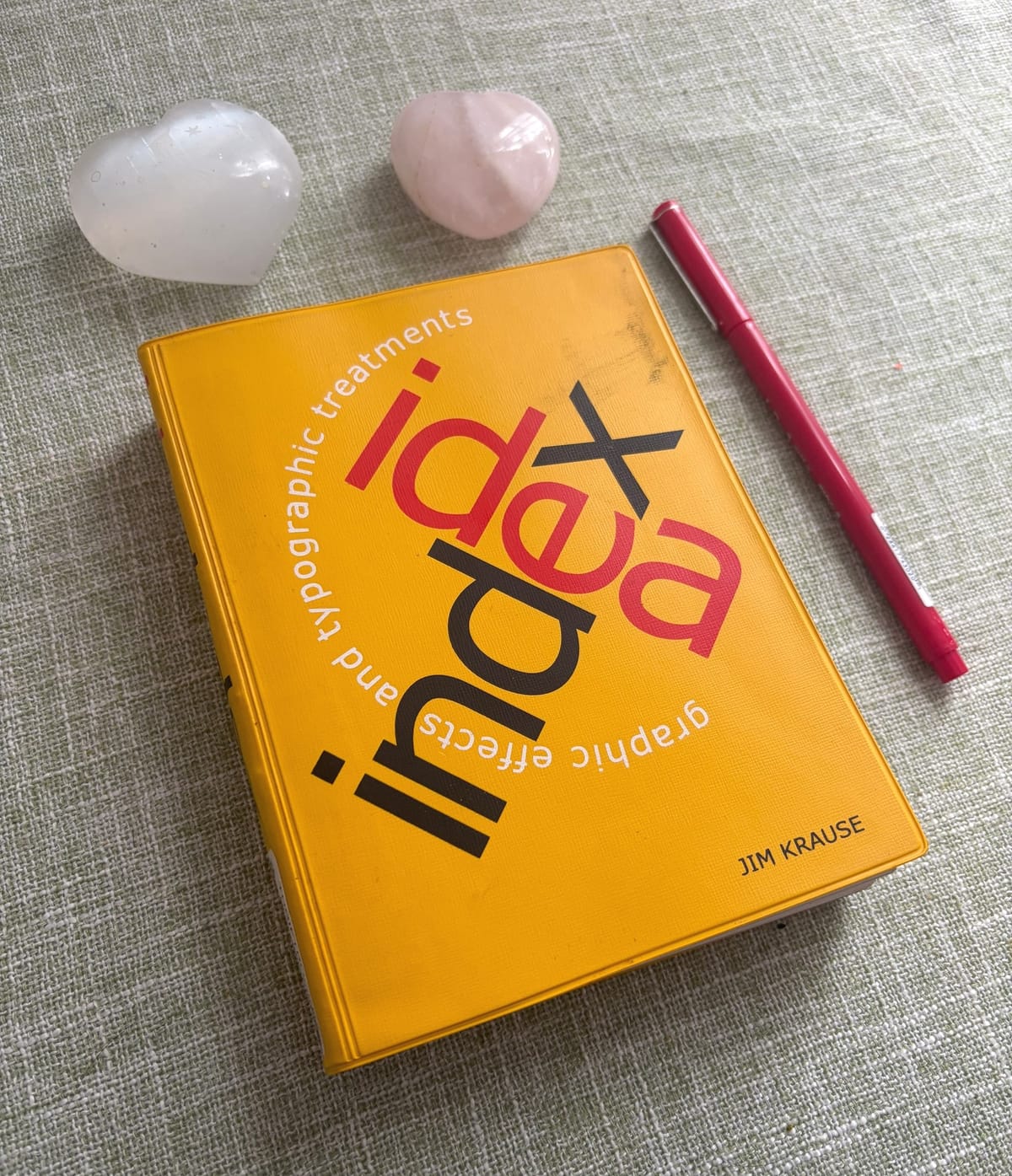
When I was working as a graphic designer, one book that stayed within close reach during client projects was The Idea Index by Jim Krause.
At the time, I used it as a brainstorming companion. When a brief felt flat or overly familiar, I would flip through its pages and let the visual treatments spark something new.
The book is filled with explorations of contrast, scale shifts, layered overlaps, texture experiments, perspective changes, symbolic imagery, and compositional adjustments.
It doesn’t dictate outcomes or tell you what to do exactly. Rather, it expands the range of possible approaches to creative work.
Now that I’ve stepped away from design, I’ve found that the book still follows me into my personal artistic work.
When I’m building prints or illustrations for Iridescent Soul Art, I’ll reconsider the scale of an element, allow a background to compete intentionally with the foreground, exaggerate highlights, introduce subtle line work, or layer textures where I normally would have left a surface clean.
Why Approach Based Art is More Important than Ever
This book encourages small shifts in perspective that can transform something predictable into something more interesting. That shift has become even more important now, in a creative landscape saturated with fast output and increasingly powerful tools.
Rapid fire generative AI technology can produce endless variations. But variation alone doesn't always create good work.
Ultimately, the deciding factor is still the vehicle guiding the process: their taste, their life experiences, their willingness to experiment. Tools amplify the direction of the work. They don’t replace it, like many people believe.
In that way, this book quietly reinforces something I’ve long understood: work you love and carries that "spark" often emerges from combining disciplines. Whether that looks like hand-drawn marks layered with digital refinement or traditional materials meeting software. In my experience, commercial design instincts intersecting with personal storytelling.
The mixing of the elements is where the voice begins to surface.
My copy of this treasured book is worn. The spine is cracked and the edges are stained from years of flipping back and forth. I found it secondhand, and I’ll probably continue to preserve it. It’s one of those books that reminds me how many ways there are to approach what I’m already making.
And sometimes, that reminder is all I need.
There are hundreds of techniques packed into that square book. Small compositional shifts, texture ideas, perspective experiments that can quietly change the direction of a piece. If you’re interested in exploring it yourself, you can find The Idea Index here.
(This is an affiliate link, which means I may earn a small commission if you choose to purchase — at no extra cost to you. I only share books and tools I genuinely return to and use.)