7 Ways to Reduce the Bulk of Your Creative Journals
These creative journal bulk reducing tips will help you if you want your journals to not explode 4 spreads in.

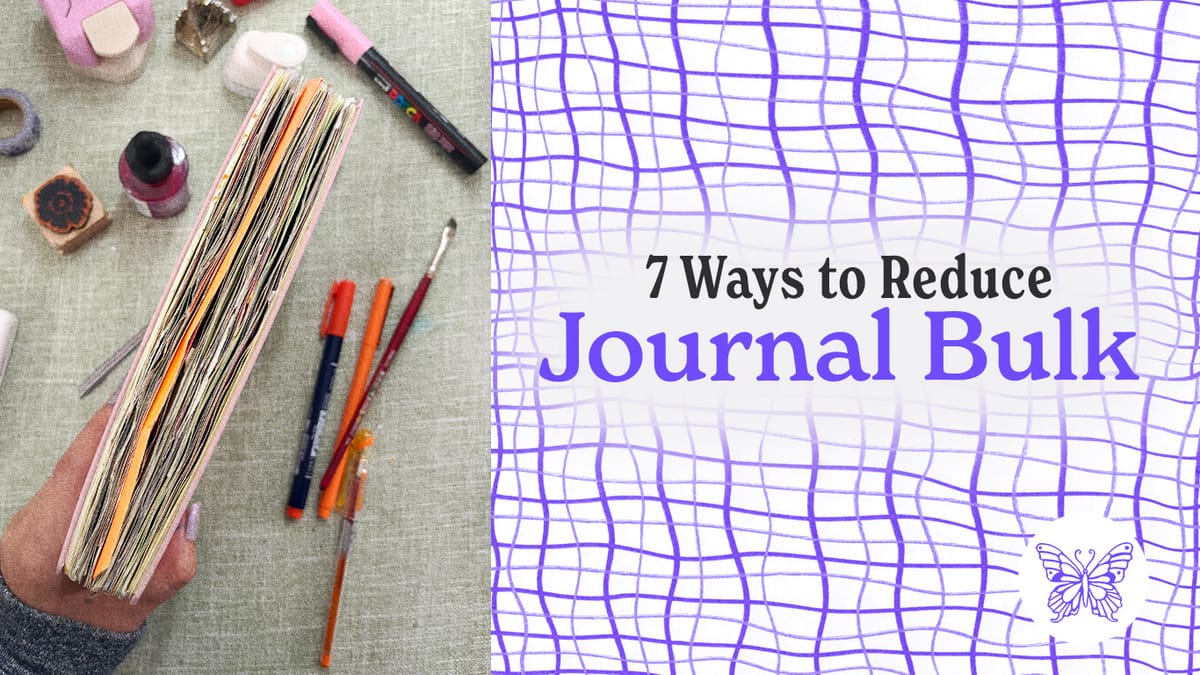
If you love layering, collage, and ephemera, you’ve probably run into this moment: your journal starts to misbehave. Pages won’t close, spines swell, and suddenly creating feels more like wrestling paper than enjoying the process.
The way I see it, reducing bulk isn’t about making your journal “minimal” or taking the fun out of it. I love a bulky fat journal , but for the sake of the way I store my journals, I have a weird sense of what I consider the right thickness. It's different for everyone though so these tips will help you if you want your journals to not explode 4 spreads in.
Here are a few ways I manage bulk in my own creative and junk journals.
- Cut the sheet in half (or cut a shape instead)
You don’t always need a full page for every idea. Cutting a page in half or removing a large shape from the center instantly reduces thickness while still giving you space to work. - Core out the middle to create a window
Cutting a window into the center of a page with a cutting knife keeps the page lightweight and creates built-in layering opportunities. Bonus: whatever shows through becomes part of the design. - Peel thicker ephemera down to its thinnest version
Whether you’re using store-bought or handmade ephemera, see if it can be gently peeled, split, or separated into thinner layers. Often the top layer holds all the visual interest without the extra bulk. - Rip pages and reuse them as smaller note pieces
Instead of adding more paper, pull from what you already have. Tear pages into smaller squares or strips and reuse them for notes, lists, or quick marks. It keeps the journal lighter and more cohesive. (its okay to rip pages out if you want, but if you feel that it doesn't feel good, you also don't have to do it.) - Glue pages together
Either ocassionally or between spreads. This adds strength without adding thickness and helps stabilize chunkier sections. - Write or draw on every other page
Leaving intentional gaps where you don't glue or layer anything gives the spine a break and creates space for future layers. You can always come back later or let the empty page stay empty. - Use ink washes or paint instead of adding paper
Paint, ink, and watercolor add richness without physical bulk. An inkwash can do the work of multiple layers while keeping the page flexible.
Why this matters (and how I use it)
I use these tactics constantly, especially when I’m working on junk journals and mini junk journals. Smaller formats naturally demand lighter pages, so managing bulk becomes part of the creative rhythm instead of an afterthought.
If you’re curious how this looks in practice, I wrote a micro post all about it:
👉 My World of Mini Junk Journaling
It’s a peek into how I scale ideas down, reuse materials, and keep my journals functional and expressive. Reducing bulk is about making room to keep creating.